What Chandler's Median Home Price Actually Hides
August 13, 2026
August 13, 2026
A buyer comparing Chandler to the rest of the East Valley this summer will do what everyone does: pull up three sites in the same afternoon and write down three different numbers. One tracker puts Chandler's median sold price at $500,000 over the trailing six months through July 2026. Another, working from ARMLS list-price data as of July 14, 2026, shows $559,900. A third, updated in June 2026, lands at $535,000. Same city, same summer, three medians that don't agree with each other by nearly $60,000.
That gap isn't a data error. It's the first clue that Chandler doesn't behave like one housing market wearing a single ZIP code range. It behaves like at least three markets stacked on top of each other, and the citywide median is just the blended average of all three pretending to be one number.
Part of the spread comes down to methodology. A six-month rolling median smooths out seasonal swings but lags behind what's happening right now. A point-in-time list-price snapshot captures what sellers are asking today but says nothing about what actually closes. A third source pulling from multiple data providers averages out both.
That explains some of the gap. It doesn't explain all of it. A $60,000 spread on a roughly $530,000 base is a 10 to 12 percent swing, which is too large to chalk up entirely to timing differences. The more useful explanation is that Chandler's transaction mix itself is uneven: a $2.515 million luxury closing in the east Chandler 85249 corridor in February 2026 sits in the same dataset as entry-level condos and resale ranch homes going for a third of that price. Average enough of those together and you get a median that describes almost nothing specific about any one buyer's search.
For someone deciding where in Chandler, or whether Chandler at all, the citywide figure is a starting point at best. The real answer depends on which of Chandler's submarkets you're actually shopping in.
One reason Chandler resists a single, simple price story is that its demand isn't purely cyclical. Intel has operated in Chandler since 1980, and the company's continued investment in its Chandler campus has helped anchor what one industry outlet described in April 2026 as one of the Valley's most enduring advanced manufacturing corridors. Coverage published in June 2026 adds another data point: Applied Materials has committed a $200 million investment to a Chandler facility, part of a broader pattern of semiconductor-adjacent capital flowing into the East and North Valley.
None of this is happening in a vacuum. Just days ago, on July 27, 2026, TSMC announced an additional $100 billion investment in its Arizona operations, bringing its total planned Arizona spending to $265 billion. TSMC's fabs sit in north Phoenix, not Chandler proper, but the ecosystem of suppliers, engineers, and support companies that orbits both Intel's Chandler campus and TSMC's footprint doesn't respect city lines. It shows up as steady, well-compensated demand for housing along the Price Corridor, the stretch of Chandler closest to these employers.
That's a structural floor, not a speculative wave. It's also uneven across the city. A resale home a mile from the Price Corridor competes for a buyer pool with a paycheck and a commute in mind. A home twenty minutes further out competes on different terms entirely.
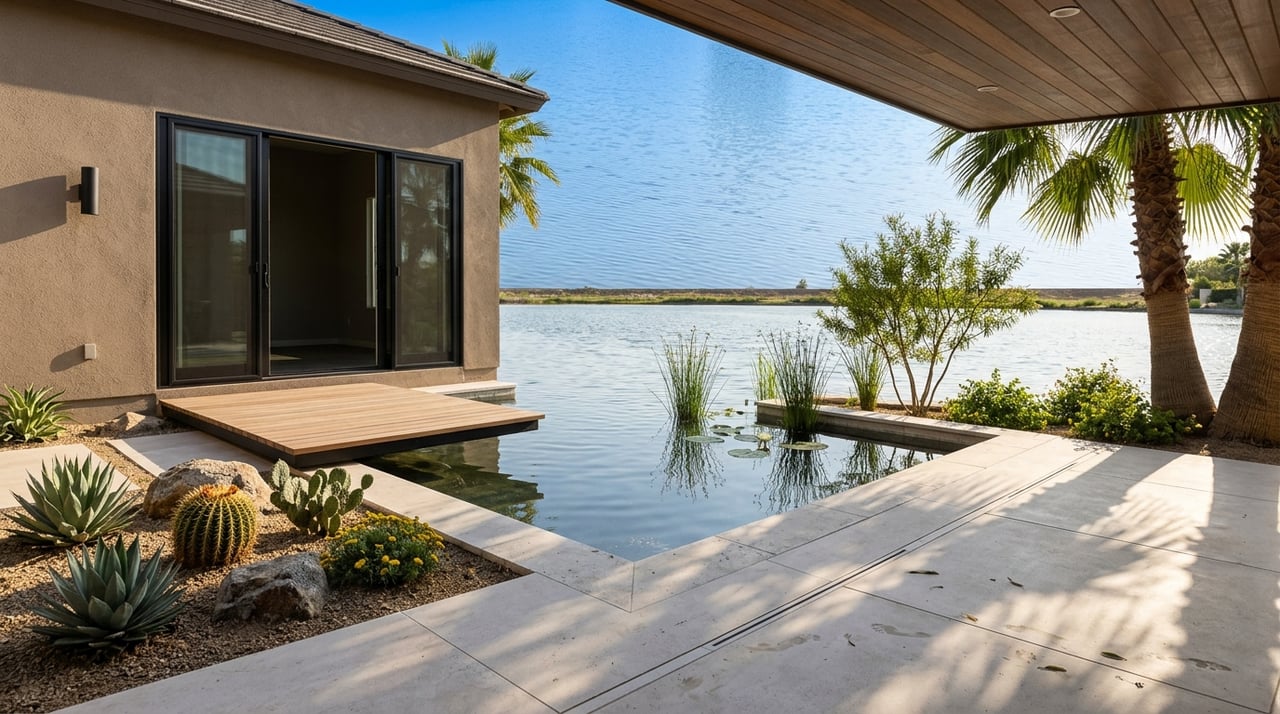
Nowhere is that unevenness more visible than in Ocotillo, the roughly 1,900-acre master-planned community in south Chandler built around a 162-acre interconnected lake system with 17 miles of shoreline, anchored by a 27-hole golf course designed by Ted Robinson. Ocotillo isn't one price point. It's a ladder.
| Ocotillo Tier | Typical Price Band | What Sets the Price |
|---|---|---|
| Condos and townhomes (Corona del Mar, Cantabria Shores, Monterey Bay) | From roughly $399,000 | Entry-point ownership, lock-and-leave, no direct water access |
| Interior single-family resale (Ocotillo Lakes, The Legend) | Roughly $550,000 to $800,000 | Established homes, Chandler Unified boundaries, no lake or golf frontage |
| Lakefront and golf-frontage estates (The Peninsula, Crown Point, Villas at Ocotillo) | $900,000 to more than $2 million | Direct water or fairway orientation |
The premium for that top tier is documented and specific: lakefront and golf-frontage positioning carries a 20 to 30 percent price advantage over comparable interior properties, with price per square foot ranging from roughly $250 to $400 depending on orientation, renovation level, and which of the community's enclaves the home sits in. Put in dollars, a $700,000 interior comp with lake frontage a few doors down can reasonably ask $840,000 to $910,000 for the same square footage. That's not a rounding error. That's the water.
Demand for that premium hasn't been soft. Ocotillo saw 146 homes close in 2025 across roughly forty distinct neighborhoods built out by Fulton Homes, Shea Homes, UDC, and Trend Homes, a transaction pace that suggests buyers are still willing to pay for the lake even as the broader Phoenix market has cooled from its 2021-2022 peak.
While Ocotillo's resale market keeps absorbing inventory at a premium, new construction across the county is struggling in a way that changes where the actual deals sit in 2026. New homes accounted for just 15.8 percent of the Maricopa County market in June 2026, down from 20.8 percent the same time the year before, a decline of more than 24 percent in market share. Over that same stretch, resale prices managed a small 1.1 percent increase year over year while new home prices fell 3.4 percent.
That's close to the opposite of the assumption most buyers walk in with, which is that new construction commands a premium over resale. In Chandler right now, it's the builders who are cutting price and layering in incentives to move inventory, while resale homes in established, amenity-anchored communities like Ocotillo hold their ground. A buyer chasing a discount in 2026 is more likely to find one in a new-build community than in a lakefront resale listing.
Even on the resale side, pricing discipline matters more than it did a few years ago. Homes across Chandler are still closing near list price once they go under contract, but a meaningful share of active listings need at least one price reduction to get there. The homes that sell fastest and closest to asking are the ones priced against real, recent comps from the start, not against what a similar home sold for eighteen months ago.
Return to that $2.515 million closing in the 85249 corridor in February 2026. On its own, it looks like an outlier next to a citywide median sitting somewhere between $500,000 and $560,000. It isn't a contradiction. It's a snapshot of exactly how Chandler's median gets built: a small number of high-value transactions in submarkets with genuine scarcity, folded into a much larger volume of resale activity across the rest of the city.
That's the thesis in one sentence. Chandler's median price isn't wrong. It's just answering a question nobody asked, which is "what did an average transaction across every submarket in Chandler look like," instead of the question that actually matters to a buyer, which is "what does my budget buy in the specific part of Chandler I'm considering."
Is Chandler a buyer's market or a seller's market right now? It depends on which slice you're in. Cromford Market Index tracking earlier in 2026 showed Chandler leaning toward sellers, and the more recent split between new construction and resale suggests that lean is not uniform heading into the second half of the year. New-construction communities are showing more buyer leverage given falling new-home prices and shrinking market share as of June 2026, while established, amenity-driven resale communities like Ocotillo have kept absorbing inventory without much discounting.
Does the citywide median price apply to new construction too? Not evenly. New home prices in the county fell 3.4 percent year over year through June 2026 while resale prices rose 1.1 percent over the same period, meaning a citywide median blends two segments moving in opposite directions.
Why do two similarly sized homes sell for such different prices in Chandler? Location within the city matters more than square footage in several of Chandler's most distinct submarkets. A lakefront or golf-frontage position in Ocotillo carries a documented 20 to 30 percent premium over an interior lot of the same size, and proximity to Price Corridor employers like Intel adds a separate layer of durable demand that shows up in price even when broader market conditions cool.
If you're trying to figure out what your number actually buys in Chandler, or whether a different East Valley submarket makes more sense for your budget and timeline, Cavanaugh Luxury Group can walk you through the comps that matter for your specific search. Request a private consultation to get a read on the market that goes past the median.
We’re dedicated to guiding you through every step of your home buying and selling journey. Our commitment to luxury real estate is something we embody daily. With years of expertise, we offer comprehensive insights to ensure your experience maximizes the value we can provide for you.