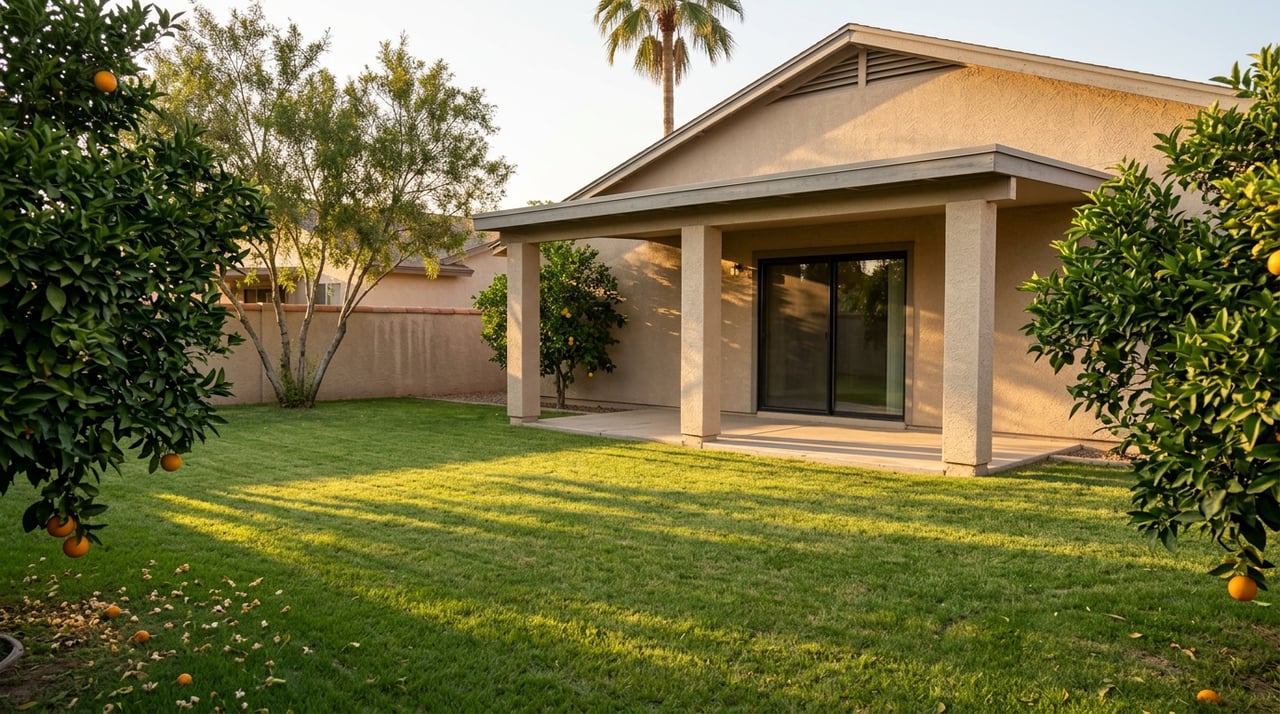
Arcadia Flood Irrigation Homes: Check the Easement First
August 20, 2026
August 20, 2026
A buyer under contract on a rebuild lot in Arcadia got the SRP paperwork back from title three days before closing. The water right transferred fine. The turnout was active, the account was current, nothing dramatic. Then the pool contractor pulled the survey and found the irrigation lateral ran directly under where the plans called for the spa and equipment pad. The pool didn't die. But the footprint moved, the permit timeline slipped, and the buyer spent two weeks on the phone with SRP and the City of Phoenix instead of picking tile.
That's the version of flood irrigation that actually costs Arcadia buyers money and time. It has almost nothing to do with the water bill.
Most guides to Arcadia treat flood irrigation like a recurring expense buyers need to budget for, somewhere between pool maintenance and a landscaper's monthly invoice. The framing isn't wrong exactly. It's just aimed at the wrong number.
Salt River Project doesn't sell irrigation customers water. If your parcel carries an irrigation right, that water belongs to the land, a legacy of the citrus-grove era when Arcadia's lots were carved out of orchards fed by the Arizona Canal. What SRP actually bills for is delivery: an annual water delivery fee of roughly $97 per active account, plus a small per-acre basic charge that covers storage, canal maintenance, and lateral upkeep. For a typical Arcadia lot in the third-of-an-acre-and-up range, that works out to somewhere between $270 and $450 a year, billed in two installments.
That's the annual irrigation charge for delivering water to seventy-year-old citrus trees and a green lawn through a Phoenix summer. It's less than most homes here spend on pool chemicals in the same period.
The actual friction is coordination, not cost. In many Arcadia blocks, several properties share a single turnout, and someone has to be home to open and close the gate on the scheduled day, sometimes at inconvenient hours. Miss your turn and you can wait weeks for the next one. Most owners fold this into a landscaper's regular scope rather than doing it themselves, which converts a genuine responsibility into a manageable one. None of this shows up as a line item that scares a buyer. It shows up as a habit they either build or outsource.
Here's the mechanism the water-bill framing misses entirely. The lateral and turnout that deliver irrigation water don't just sit on a map. An easement can constrain where you're allowed to build, as SRP explains.
This matters most at the exact moment Arcadia buyers are most likely to need it: when they're planning a pool, a guest house, or the kind of full rebuild that defines this neighborhood's market. If an SRP easement crosses the section of the lot where a builder wants to place a pool shell, a spa, or new footings, the build plans may need to change before anyone breaks ground. Mitigation is usually possible: shifting the pool, adjusting the footprint, routing utilities shallow around the easement line. But every one of those fixes takes coordination, and none of it happens on the buyer's original timeline.
Appraisers factor this in too. When an easement meaningfully reduces buildable area or forces a pool into a worse spot on the lot, it can affect how the property's highest and best use gets valued, even if the home itself shows perfectly. A clean, stamped survey that documents the easement and shows a strong remaining build envelope tends to keep that impact minimal. A murky one doesn't.
This is the part of Arcadia's irrigation story that a general Phoenix agent is likeliest to miss entirely, because it never shows up in the SPDS checkbox for irrigation. It shows up in a civil survey.
Arizona sellers complete a Seller's Property Disclosure Statement, the form local agents still call the SPDS, and its utilities section explicitly asks about irrigation service. Nolo explains that Arizona courts have held that a seller has to disclose known material facts that affect a property's value or desirability, even in an as-is sale.
The twist is how differently two kinds of buyers read the exact same disclosure. A buyer who grew up around Arcadia's ditch culture sees a scheduled flood day and thinks nothing of it. A buyer relocating from a state where a flooded backyard means something went wrong can read that same line item as a defect. Sellers who spell out the schedule, the approximate annual cost, and the fact that this is original infrastructure rather than a leak tend to avoid the awkward re-explanation during escrow. Sellers who leave it vague invite exactly the kind of question that slows a transaction down in its final week.
Arcadia isn't priced like a typical Phoenix zip code, and irrigation status is part of why. As of the July 2026 market snapshot, the neighborhood's single-family segment carried a median sale price around $1,545,000, up modestly from a year earlier, at roughly $618 per square foot, with about 79 homes sold and a median 74 days on market. Cash buyers made up close to a third of transactions overall, and that share climbed above half once you looked only at sales above $3 million.
Those numbers hide more than they reveal, because Arcadia isn't one market. Locals split it into Arcadia Proper, the historic core south of Camelback with the largest original irrigated lots and the highest prices, and Arcadia Lite to the west, where lots run smaller and the entry point is friendlier. A rebuild lot with clean irrigation documentation and a wide build envelope in Arcadia Proper competes on completely different terms than a similar-looking lot where the easement eats into the pool area. Builders active in the neighborhood right now include Carmel Homes, Cullum Homes, Sever Custom Homes, Bedbrock Developers, Calvis Wyant Luxury Homes, and Thomas James Homes. Separately, original-condition lots in the neighborhood tend to sell inside a month when they hit the market.
Arcadia's near-total absence of HOA governance compounds this. Without an association reviewing remodels or landscaping, the irrigation easement is often the only real constraint on what you can do with a lot, which raises its importance rather than lowering it.
If you're evaluating an Arcadia property with irrigation rights, the questions worth asking go past "does it flood irrigate."
None of these questions are expensive to ask. They're just easy to skip when the water bill looks this small and the rest of the deal looks this clean.
Does every Arcadia home have flood irrigation? No. SRP explains that irrigation rights belong to the land; rights are parcel-specific and tied to the original citrus-era land grants, so some lots on the same block have active delivery and others were decommissioned decades ago. Always confirm status for the specific parcel rather than assuming based on the neighborhood.
Does an irrigation easement always block a pool? Not always, and often it doesn't. Many lots have enough buildable area around the easement that a pool simply shifts a few feet. The risk is discovering the constraint after plans are finalized rather than before you write the offer.
If you're weighing a lot in Arcadia Proper against one in Arcadia Lite, or trying to figure out what a specific easement means for your rebuild plans, that's exactly the kind of lot-by-lot judgment call worth making with someone who works this neighborhood every week. Cavanaugh Luxury Group can walk through the survey, the SRP documentation, and what it actually means for your offer. Request a private consultation before you write one.
This article is general information, not legal, tax or financial advice. Consult a qualified professional about your situation.
We’re dedicated to guiding you through every step of your home buying and selling journey. Our commitment to luxury real estate is something we embody daily. With years of expertise, we offer comprehensive insights to ensure your experience maximizes the value we can provide for you.