The Hillside Math That Decides How Big Your Paradise Valley Estate Can Be
August 27, 2026
August 27, 2026
Two lots on the same Paradise Valley street can carry nearly identical price tags per acre and still allow houses that differ by thousands of square feet. The gap rarely shows up in a listing description, a comp sheet, or a broker's price-per-acre math. It shows up on a slope survey, months into design, when an architect tells a buyer how much of the parcel they are actually allowed to touch.
That number, not the acreage on the deed, is the real ceiling on hillside estates in Paradise Valley.
Paradise Valley's Hillside Development Regulations, codified as Article XXII of the town's zoning ordinance, apply to any parcel with a natural slope of 10 percent or steeper. A wash cutting through an otherwise gentle lot can be enough to trigger the rule even if most of the property reads as flat. The ordinance exists, in the town's own framing, to control how intensely sloped land can be developed and to protect the foothill terrain that gives the town its identity.
The mechanism at the center of Article XXII is the disturbed area cap. Disturbed area means any ground altered by grading, cutting, filling, clearing native vegetation, or trenching for utilities, and the ordinance limits what share of a hillside lot can carry that disturbance. The limit tightens as the slope steepens:
| Building-site slope | Maximum disturbed area |
|---|---|
| 10% | Up to 60% |
| 15% | About 34% |
| 25% | About 13% |
| Beyond 50% | Single digits |
Two three-acre lots with the same list price can land at opposite ends of that table. A 10 percent slope leaves room for a generous footprint, a pool deck, and a motor court. A 25 percent slope on a neighboring parcel can leave less than a seventh of the site available to build on, park on, or landscape beyond native desert. The acreage is the same. The house that fits is not.
This is why buyers evaluating a Paradise Valley hillside lot should ask for a slope analysis before they fall in love with a view, not after.
Every new hillside home in Paradise Valley goes through the town's Hillside Building Committee, a six-member panel made up of citizen appointees and rotating Planning Commissioners. The committee's review goes well past a simple grading permit. It examines land disturbance against the Table 1 limits, but it also weighs:
Before a permit is issued, an applicant also has to post financial assurances with the Town Attorney's office and file a construction staging plan. None of this is paperwork a buyer can skip by working with an aggressive contractor. The town's own hillside application packet makes clear that clearing, grading, blasting, or any movement of earth cannot begin until the committee has approved the plans and permits are in hand.
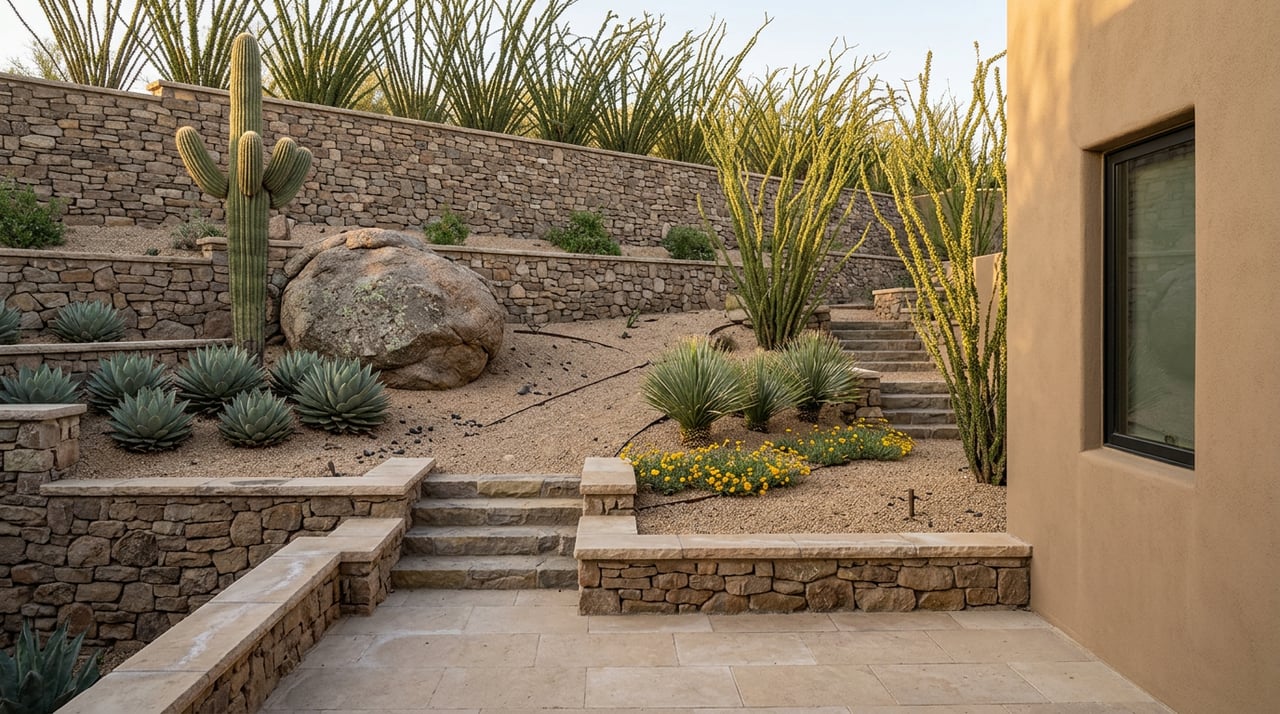
The disturbed area cap does not just shrink the footprint. It reshapes the budget. Site work and foundation costs on a hillside lot, where piers go into granite and retaining walls step down the grade in tiers, commonly run far higher as a share of total project cost than the same category on a flat parcel closer to Lincoln Drive. Utility trenching through rock, multi-tiered retaining walls, and engineered grading plans all add cost precisely where a flat lot would add none.
Timeline follows the same pattern. A flat parcel without hillside review or heavy HOA design scrutiny can move from purchase to occupancy considerably faster than a hillside build, which routinely stretches well past two and a half years once pre-application review, committee approval, geotechnical work, and staged construction are factored in. Buyers pricing a hillside lot against a flat one on land cost alone are comparing two very different construction timelines and two very different budgets, even before the first stake goes in the ground.
Paradise Valley gives hillside owners a couple of formal ways to work with the disturbance limit rather than against it.
The first is procedural. Any new construction or addition valued at $500,000 or more triggers a required Native Plant Preservation Plan, filed with the building or grading permit application. Protected native plants on the site have to be surveyed and either preserved in place or relocated on or off the property, with a certification required before final inspection. For a luxury build in this price range, that plan is not optional paperwork. It shapes where equipment can stage and where the disturbed footprint can actually sit.
The second is a longer-term decision some hillside owners make voluntarily. A property owner can donate all or part of the undeveloped portion of a hillside lot as a conservation easement, historically directed to what was founded in 1997 as the Mummy Mountain Trust and has since been reinvigorated as the Paradise Valley Mountain Preservation Trust. According to the trust's own reporting, roughly 240 acres of hillside terrain around Camelback Mountain, Mummy Mountain, and the eastern edge of Phoenix's North Mountain Preserve have been protected this way over roughly two decades of donations. A conservation easement permanently forecloses development on that portion of the lot, which can reduce or eliminate the owner's property tax exposure on that acreage, but it is not something an owner can undo later if their plans change.
Neither path adds buildable square footage back to a steep lot. Both change what an owner does with the acreage the ordinance already puts off limits.
Paradise Valley's zoning code dates to 1974, with more than a hundred amendments layered on since. The town has been working through a full rewrite intended to make the code easier to use, and the hillside disturbed-versus-undisturbed definitions are part of that review. None of the core numbers in this piece are expected to have flipped by the time a reader is comparing lots this fall, but a buyer under contract on a hillside parcel, or a seller marketing one, should confirm current standards with the town's Planning and Building Department before finalizing a design or setting an asking price around assumed buildable area. A rule that has held for years is still worth a phone call before money moves.
Does the 10 percent slope threshold apply to the whole lot or just where the house sits? It applies to the natural grade of the property, and a wash or a steep pocket on an otherwise gentle lot can be enough to pull the parcel into hillside review even if the building envelope itself sits on flatter ground.
Can a buyer get a variance to disturb more than the table allows? The Hillside Building Committee reviews each application against Article XXII and the town's Hillside Safety Improvement Measures and Process Manual, and any request to exceed standard limits goes through that same committee process rather than a simple administrative sign-off.
Does a conservation easement donation lower the purchase price of a hillside lot? An easement restricts development permanently and applies to future owners, so a buyer evaluating a lot with an existing easement should treat the protected acreage as unbuildable land, not as bonus acreage reflected in the price.
Is the height limit measured from the street or from the house pad? Height is generally measured from grade at each point along the structure, which is why a home stepped into a slope can differ significantly in apparent height from one built with a single flat foundation plane.
Hillside lots in Paradise Valley reward buyers who read the slope survey as carefully as the listing photos. If you are comparing view lots, weighing a hillside build against a flatter parcel, or trying to understand what a specific Paradise Valley property can actually support before you design around it, Cavanaugh Luxury Group works this market directly. Request a private consultation before you fall for the acreage on paper.
We’re dedicated to guiding you through every step of your home buying and selling journey. Our commitment to luxury real estate is something we embody daily. With years of expertise, we offer comprehensive insights to ensure your experience maximizes the value we can provide for you.